
Christopher Aruffo, MFA, MBA, MSc, PhD
The poet has already done most of the work for you. Verse is created by arranging words into equal feet and equal lines. Problems only arise where your natural pronunciation is different enough to create inequality. Where your pronunciation is the same, analysis can be as simple as reading aloud.
Therefore, start your analysis by reading aloud. Read naturally-- don't try to perform or interpret. Above every long syllable, in the middle of the syllable, write a stress mark [ ´ ]. Leave short syllables unmarked. When you are done, you will have found all your natural stresses. These markings will help you group all the syllables into feet.
Syllable length is not always obvious. Long syllables are stressed, so they usually feel stronger and sound louder, but sometimes they don't-- especially not if you're reading quietly to yourself. Fortunately, you can also determine a syllable's length by testing the lengths of its letters. A syllable is naturally long when its letters require length.
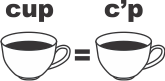
Vowels can be long or short. To test a vowel's length, delete it. When a vowel is short, it doesn't need length, so you can still say the word correctly.
|
|
|
| A short vowel can be deleted. | A long vowel requires length. |
For example, deleting the vowel from cup makes it c'p, but c'p can still sound like cup. Therefore, cup has a short vowel. On the other hand, ball becomes b'll, and b'll sounds like bull (or bill). You can't say b'll and make it sound like ball. Therefore, ball has a long vowel.
A long vowel automatically makes its syllable long. Whenever you find a long vowel, mark its syllable and move on. For syllables with short vowels, you can determine length by counting consonants.
The more consonants a syllable has, the more stressed it becomes, because the longer it takes to say them all (it, pit, spit, spits, spritz, sprints). One consonant is relatively effortless, and is therefore always naturally short (if, at, of). Four or more consonants are relatively effortful; therefore, these always make a syllable long (flushed, strengths, squished).
 |
 |
| One consonant is effortless. | Four consonants are effortful. |
A syllable with two or three consonants may be relatively long or short compared its neighbor. For example, per is stressed compared to a shorter syllable (person), but is unstressed compared to a syllable that has four consonants (perplexed) or a long vowel (super). To test a syllable that has two or three consonants, compare it to adjacent syllables. Whichever syllable requires more effort will seem stressed.

Two or three consonants can require more or less effort.
One way to compare syllables is by exaggerating stress. Stress is increased by length, loudness, or pitch; therefore, try saying a syllable much longer (suuuuuper, superrrrr), or much louder (SUper, suPER), or at a much higher pitch. Exaggerating stress can make obvious which syllables may be naturally stressed.
In English, stressed syllables draw attention to themselves. Stress makes a syllable prominent and emphasizes its meaning. By marking all naturally-long syllables, you determine which syllables are naturally more important.
| , , , , , My former speeches have but hit your thoughts, , , , , , Which can interpret further: only, I say, , , , , , Things have been strangely borne. The gracious Duncan , , , , , , Was pitied of Macbeth: marry, he was dead: , , , , , And the right-valiant Banquo walked too late; , , , , , , Whom, you may say, if it please you, Fleance killed, , , , , , , For Fleance fled: men must not walk too late. , , , , , , Who cannot want the thought how monstrous , , , , , It was for Malcolm and for Donalbain , , , , , To kill their gracious father? damned fact! , , , , , , How it did grieve Macbeth! did he not straight , , , , , In pious rage the two delinquents tear, , , , , , That were the slaves of drink and thralls of sleep? , , , , , , Was not that nobly done? Ay, and wisely too; , , , , , For 'twould have angered any heart alive , , , , , To hear the men deny it. So that, I say, , , , , , , , He has borne all things well: and I do think , , , , , That had he Duncan's sons under his key-- , , , , , , , As, and it please heaven, he shall not-- they should find , , , , , What 'twere to kill a father; so should Fleance. , , , , , , But, peace! For from broad words, and 'cause he failed , , , , His presence at the tyrant's feast, I hear , , , , , Macduff lives in disgrace. Sir, can you tell , , , Where he bestows himself? |
<< Previous section |
Next section >> |
||
|
Order
the printed book of this online guide. Perfect paperback, 65 pp. |
All contents of this page are copyright ©2012 Acoustic Learning Inc. All rights reserved.
